


🎥 AIPEVI sur YouTube – Inspirez, apprenez, agissez
Découvrez sur la chaîne AIPEVI YouTube une bibliothèque de vidéos pédagogiques, inspirantes et engagées, dédiées à l’agriculture durable : https://www.youtube.com/@AIPEVI68300
👉 Une partie des contenus est en libre accès (~20 vidéos), tandis que quelques vidéos plus approfondies, techniques et exclusives sont réservées aux abonnés AIPEVI Pass.
🌱 Ce que vous trouverez sur notre chaîne
- Reportages vidéo avec les fondateurs et CEOs de startups agricoles en France et en Suisse, ainsi qu’avec des PME agricoles en Autriche.
- Témoignages et reportages terrain avec des agriculteurs, principalement en France et en Suisse.
- Teasers et suivis de nos projets en agriculture urbaine : mise en place d’un protocole de dépollution des sols et installation d’un jardin urbain sur la toiture d’un immeuble, au 8ᵉ étage en pleine capitale.
- Temps forts et compilations vidéo de nos événements.
- Vidéos et résumés de tables rondes issues de salons agricoles internationaux (INDAGRA – Roumanie, AGROMEK – Danemark, SIA – France), captés sur le terrain par les membres d’AIPEVI présents lors de ces événements.
Nos dernières vidéos
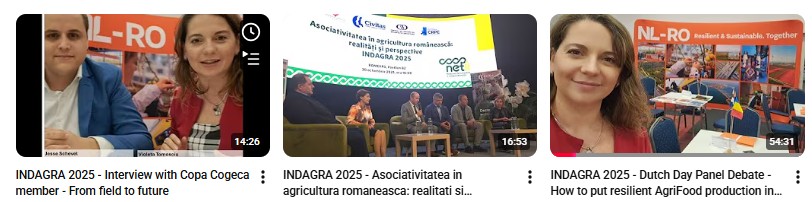
Les résumés d’événements en anglais ou bilingues seront détaillés en anglais pour une période limité ouvert a tous sans engagement. Seulement après archivage seront réservés aux abonnés AIPEVI uniquement, avec traduction possible via le plugin du site.
INDAGRA 2025 – Interview with Copa Cogeca member – From field to future – See in the video comments directly on youtube a condensed summary and here below a more detailed version (click the arrow of each chapter)
Fields to Future
- The path forward is collaboration, shared innovation, and cross-border learning — not reinventing the wheel in 27 countries.
- Europe faces growing geopolitical and trade pressure, making food security a strategic priority.
- The future CAP (post-2028) risks fragmenting rural development funding, reducing dedicated support for sustainability investments.
- Farmers must diversify: not only food producers, but also energy producers (biogas, solar, wind) under the Clean Industrial Deal.
- Water scarcity is rising across Europe — saving water must go hand in hand with EU investment in irrigation infrastructure and precision systems.
- Up to 25% of water is lost before reaching fields due to outdated infrastructure, not farmer inefficiency.
- Faster approval of biocontrol solutions is essential to replace chemical pesticides and keep EU farmers competitive.
- Agriculture must be fully included in the EU’s upcoming competitiveness and innovation funds, alongside industry and tech.
- Romania and the Netherlands face similar challenges and should innovate together, not separately.
- Romania offers major strengths: renewable energy potential, water-efficiency experience, and rich biodiversity.
Trade, Food Sovereignty & Resilience
- Food sovereignty cannot be declared without production capacity. COVID and current geopolitical tensions showed clearly that Europe must be able to feed itself in times of crisis. That requires strong, competitive farms inside the EU.
- Trade agreements are not the problem per se, but they become a threat when European farmers compete under stricter rules, higher costs, and fewer tools than producers outside the EU.
- Different sectors experience trade differently: international sectors (like greenhouse horticulture) depend on open markets, while others (beef, dairy, sugar) are far more exposed and vulnerable. One-size-fits-all trade policy does not work.
- If Europe signs trade agreements, it must also empower farmers with access to irrigation, modern infrastructure, plant protection solutions (including biocontrol), affordable energy, and labour. Competitiveness cannot exist without these fundamentals.
- Resilience is built through partnership, not isolation. The Dutch “Triple Helix” model—government, industry, and education working together—proves that complex challenges (energy, water, labour) can be tackled faster and better collectively.
- This collaboration should scale up from national to European level, so the 27 Member States innovate together instead of fragmenting solutions.
- Europe often talks about competitiveness, but agriculture is still underrepresented in major innovation and competitiveness funds, despite being foundational to the EU economy.
- The next EU mandate is critical: production conditions inside the EU must improve, otherwise farmers will continue to exit the sector and food sovereignty will remain a slogan, not a reality.
Investing in Agriculture When Subsidies Decline
- It is increasingly clear that the CAP budget will likely decrease, even if exact figures are not yet known. Farmers must prepare for a future with less direct support.
- This means investment will not disappear—but it must come from new sources and smarter structures, not only from traditional agricultural subsidies.
- Competitiveness funds, the Clean Industrial Deal, and the upcoming Water Resilience Strategy can become key financing tools for agriculture, even if they are not labeled as “agricultural” funds.
- Accessing these funds requires a different approach: collaboration instead of individual applications, and projects framed around innovation, energy, water, and technology.
- The Triple Helix model (farmers + universities + businesses/startups) makes this possible by combining: real on-farm needs, academic research and validation, technological and digital expertise.
- A concrete example is robotization in greenhouses: growers define the problem, universities (e.g. Wageningen) bring scientific knowledge, and startups contribute programming and automation skills.
- This joint structure significantly increases credibility and eligibility for EU innovation and competitiveness funding.
- The future of agricultural investment will depend less on subsidies alone and more on how well farmers position themselves inside broader EU innovation and resilience agendas.
Key Take Away – Fields to Future – Resilient Agri-Food Systems in Times of Change
- Food security is now strategic in Europe: geopolitics, trade tensions, and climate pressure require a stronger, more resilient agri-food system.
- The post-2028 CAP may weaken sustainability investments, so agriculture must also access EU competitiveness, innovation, clean-transition, and water-resilience funds.
- Resilience starts at home: food sovereignty is impossible without strong EU production capacity able to withstand crises like COVID or geopolitical shocks.
- Trade can work—but only if conditions are fair: open markets must be matched with access to irrigation, plant protection tools (including biocontrol), affordable energy, and labour for EU farmers.
- Farmers must diversify their role: beyond food production, becoming energy producers (solar, wind, biogas) and contributors to the green transition.
- Water scarcity is a European issue: efficiency rules alone are not enough—Europe must invest in modern irrigation infrastructure and precision systems.
- The Triple Helix model (government + industry + education) enables faster decisions, better policies, and real innovation on the ground.
- As subsidies decline, investment will depend on collaboration and creativity, not subsidies alone.
- Examples like greenhouse robotization show how combining farmers’ needs, academic research, and startup innovation unlocks funding and accelerates progress.
- Romania–Netherlands collaboration is essential: sharing best practices on water efficiency, renewables, biocontrol, and technology strengthens EU competitiveness.
INDAGRA 2025 – Dutch Day Panel Debate – How to put resilient AgriFood production into practice – See in the video comments directly on youtube a condensed summary and here below a more detailed version (click the arrow of each chapter)
Future of Romanian Agriculture (the view of Romanian Farmers Club)
- Education is our strongest long-term investment — even if it is difficult, slow, and offers few immediate rewards.
- Since 2018, Romanian Farmers Club focused on training a new generation of agricultural entrepreneurs, capable of navigating climate, economic, and geopolitical crises.
- The Young Leaders for Agriculture program has already prepared over 500 young professionals, with a target of 1,000 by 2027 to create a true critical mass.
- Farmers must evolve from producers to entrepreneurs integrated into the agri-food value chain, managing energy, security, and sustainability challenges together.
- Romanian agriculture is entering a phase of consolidation: resilient farms grow stronger, while vulnerable ones disappear — a harsh but real trend driven by climate pressure and market volatility.
- Digitalization and technology are no longer optional, but they require time, knowledge, and support structures to be effectively adopted.
- Universities, vocational schools, and farmer organizations must work together to bring knowledge from theory to the field.
- Without coordinated action, Romania risks falling behind in the face of climate change; with education and collaboration, we can build a resilient, competitive agricultural sector.
Romania’s Agricultural Moment & EU Representation
- Romania has gained important representation at EU level, with a Romanian elected Vice-President of the Innovation Committee—a strategic opportunity for our sector.
- December 18 will be a critical moment at the EU Council: agriculture must remain a top priority, not pushed into second or third place.
- The next EU financial framework (2028–2034) brings uncertainty: although the initial estimate was €2 trillion, the realistic budget is €1.5 trillion, which means likely cuts affecting agriculture.
- Romania must prepare for intense negotiations in the next 18 months, especially regarding: budget allocations, reciprocity in production standards, international trade agreements, and competitive pressure on farmers.
- A strong Romanian presence in Brussels is needed; the goal is to mobilize a large delegation on December 18 to make our voice heard.
- The sector faces increasing pressure from climate change, digital transformation, and global competition, requiring a coordinated national strategy.
- Unity among Romanian farmer organizations is stronger than ever—essential for the upcoming EU negotiations.
- Technical universities and agricultural education must play a bigger role: it’s crucial that society understands agriculture is not “just farm work,” but a sector of innovation, technology, and national security.
- International partners (Germany, France, the Netherlands) are key allies in keeping agriculture at the center of EU decision-making.
- Young generations are better educated, more open, and more adaptable, giving Romania a chance to build a more innovative and resilient sector.
Trade, Greenhouses & Resilient Agriculture
- International trade remains essential for horticulture, but fair competition requires comparable production standards across countries.
- Europe should focus less on resisting trade agreements and more on optimizing its own production systems to stay competitive.
- In Romania, high-tech greenhouses show massive potential: 1 hectare of greenhouse = ~100 hectares of open-field crops.
- The Olam Farmigagro greenhouse in Giurgiu proves what modern agriculture can achieve: 100% automated operations, hydroponic production on coconut substrate, full drainage recycling, weekly nutrient and water analysis for product safety.
- Greenhouses reduce soil contamination, pesticide use, and environmental impact while delivering stable yields and jobs for local communities.
- Farmers’ growing interest in greenhouse visits shows a new appetite for innovation and sustainability.
- Global experience—from Asia to Europe—confirms that resilient agriculture is built through technology, education, and fair trade conditions, not by resisting change.
Building Resilience in Agriculture Through True Partnership
- The Triple Helix model (government + industry + education) has given us in the Netherlands the resilience to react fast — from energy crises to labor shortages.
- In crisis moments, collaboration accelerates: tech suppliers, growers, universities, and government sit at the same table to design robotization, digitization, and training programs together.
- Regional clusters show the same value: collective solutions like shared water treatment systems became possible only through partnership, co-financing, and trust.
- This model isn’t built overnight — it took 15 years. But every country can adapt it in its own way; it’s not copy-paste, it’s exchange of best practices.
- What matters most is a mindset shift: collaboration over isolation, innovation over fear, long-term vision over short-term fixes.
- Romania has huge potential — with younger cooperative leaders, emerging industries, and openness to new crops — but success requires entrepreneurial thinking, constant reinvention, and strategic use of upcoming EU frameworks.
- European agriculture is changing fast: the number of farms dropped by 5.4 million in two cycles — a signal that resilience must be built together, not farmer by farmer.
Conclusions
- Romania has excellent scientific talent, but too much knowledge remains “on the shelf.” We must bring research from universities to farms.
- Many small farmers lack access to advanced tech; they need practical, boots-on-the-ground solutions, not just digital models.
- A mindset shift is needed: younger experts returning from abroad must be heard, not ignored.
- Generational transition challenges aren’t only Romanian — they are European, and cooperation is essential.
- The future of agriculture will not be built through incremental change, but through new models, strong partnerships, and shared ecosystems.
Key Takeaways on Romania’s Agricultural Transition:
- Climate change is already here: crops like hemp now flower prematurely, and yields are shrinking — a warning that adaptation can’t wait.
- Education is the cornerstone of Romania’s agricultural future: only 2% of farmers have formal training, yet modern farming demands entrepreneurship, technology, and strategy.
- The transition must start in the field, not in theory: farmers need trials, new genetics, new crops, and hands-on guidance.
- Romania’s biggest advantage is land + digital talent. If we connect know-how with these strengths, we can leapfrog other EU countries.
- High-tech greenhouses show what’s possible: 1 ha = ~100 ha of open-field production, with hydroponics, recycling, and zero soil contamination.
- The Triple Helix model (government + academia + business) is essential for real resilience and innovation — and Romania can build its own version of it.
- Crop diversification is no longer optional: opportunities like millet, fiber crops, and bioplastic feedstocks are expanding rapidly with global industrial demand.
- Romania must strengthen processing capacity, branding, and value-added chains to reduce its agro-food trade deficit.
- EU negotiations ahead (2024–2034) will be critical — agriculture must stay a top strategic priority in Brussels.
- Real progress comes from collaboration, experimentation, and a generational mindset shift — not from waiting for perfect policies.
Autres vidéos récentes : https://www.youtube.com/@AIPEVI68300